Have you ever felt like your birth chart, as insightful as it is, just doesn’t capture a specific layer of your life’s story? Does traditional astrology sometimes seem to miss the mark when it comes to predicting concrete, real-world events?
You’re not alone—and there might be a reason why.
Welcome to Uranian Astrology, a precise and symmetrical system developed in the early 20th century by the Hamburg School of Astrology, led by Alfred Witte. Unlike traditional astrology’s focus on psychological tendencies, this system was designed to predict tangible events with replicable accuracy. At its heart lies something most astrologers have never encountered: eight hypothetical “Transneptunian” planets that, though not physically verified, show up with startling precision in charts—clarifying hidden patterns and revealing the unstated tensions in our lives.
These eight planets are what separate Uranian astrology from the related practice of Cosmobiology, and they’re about to transform how you read charts.
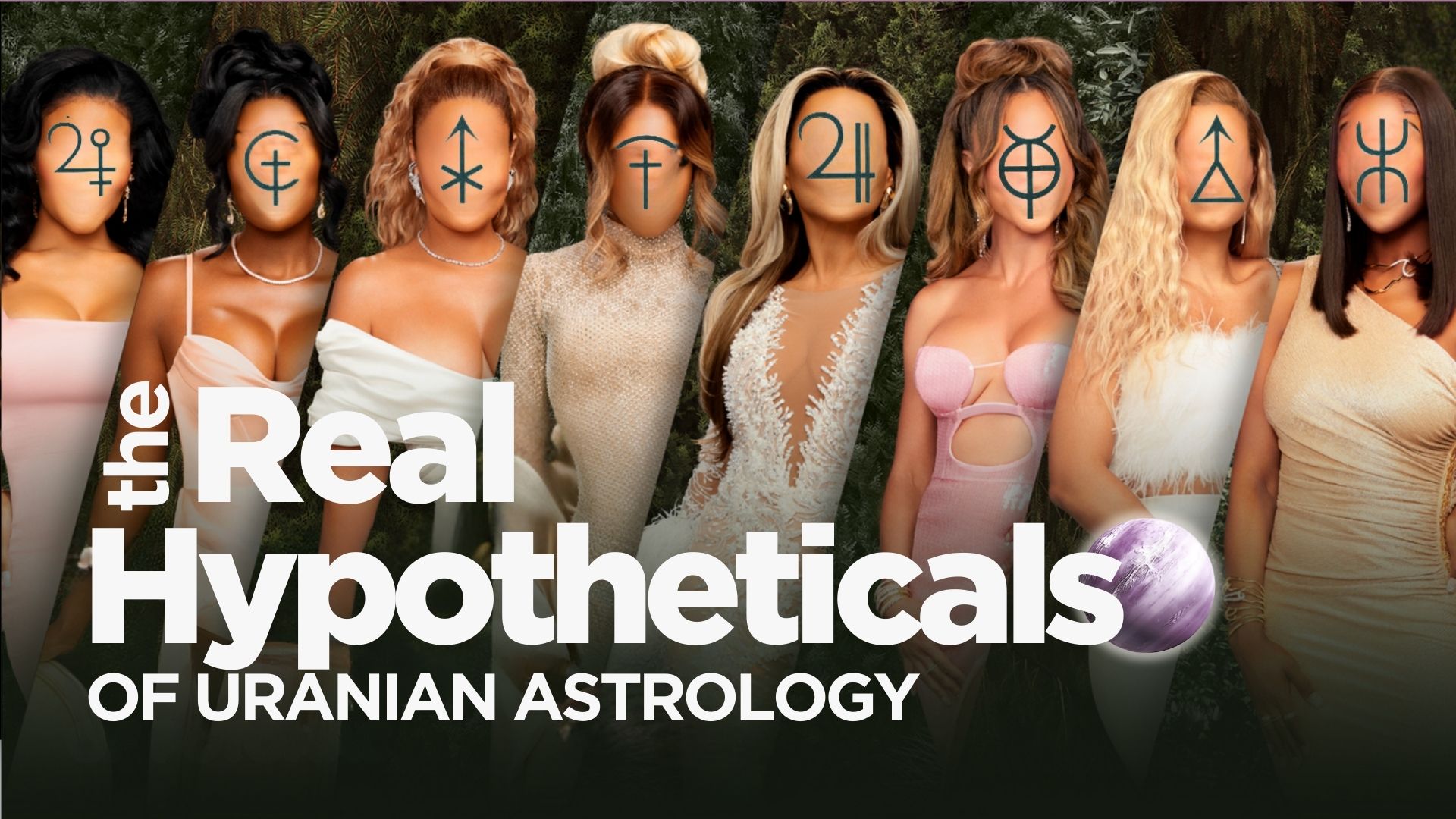
In this post, I’m going to introduce you to these eight distinct, disruptive, and dramatic energies using a framework we can all understand: the “Real Housewives.” I’ll introduce each planet as a character with its own signature energy and agenda. Think of them as the ensemble cast of your life’s most compelling storylines.
Ready to meet the cast? Let’s dive in.
Cupido: The Social Organizer
“I hosted the dinner party. What happens at the table is not my problem.”
Cupido governs togetherness, but not necessarily harmony. It’s the planet of groups, families, marriage, organizations, and art—anything where people are connected by a shared purpose or identity. Think of Cupido as the force that brings people into the same room, whether or not they should actually be there.
To see how a single Uranian formula can manifest as both a legendary career and a beloved (if messy) character, look to Matt Groening, the creator of The Simpsons and Futurama.
In Groening’s chart, we find a striking midpoint equation: Sun = Cupido = Uranus + Neptune. In the Uranian system, the Sun represents the man, and Cupido represents the husband or “family man.” When you add Uranus (rebellion, instability, the “weird”) and Neptune (imagination, illusion, and even “escapism” or “alcohol”), you get the perfect recipe for Homer Simpson—the ultimate weird, beer-loving, suburban husband.
This same formula describes Groening himself. His art (Cupido) is defined by futuristic visions (Uranus + Neptune). This energy is so potent that The Simpsons has become famous for its “spooky” precision in predicting the future—such as the 2000 episode that predicted a Donald Trump presidency and a tanking economy. Groening’s other major success, Futurama, perfectly mirrors the Uranus + Neptune influence, centering on a community of “oddball characters” living in a futuristic, imaginative world.
Hades: The Forensic Analyst
“I don’t air the dirty laundry. I archive it.”
Hades rules everything that is hidden, decaying, shameful, or secret. It’s associated with illness, poverty, misery, and the things we’d rather not look at. But before you write it off as purely negative, consider this: Hades also governs deep research, preservation, and the courageous work of those who must confront what others turn away from.
Counter-intuitively, Hades is strong in the charts of doctors, psychologists, therapists, coroners, and forensic specialists. These are the professionals who “walk into the rot not to shame it, but to understand it.” They see what’s hidden and bring it into the light—not for gossip, but for healing or justice.
For instance, MaRah Williams, co-host of the true-crime podcast “Sistas Who Kill,” has a chart showing Sun + Hades = Node, a combination that translates to an “acquaintance with criminals”—a perfect astrological signature for her line of work. Hades isn’t about dwelling in darkness; it’s about having the strength to examine it.
Predicting the Unprecedented: The 2020 Global Health Crisis
When the world came to a standstill in early 2020, traditional charts showed tension, but Uranian astrology revealed the specific signature of a pandemic. By looking at the eclipse chart just before the global lockdown, we can see the “hidden players” that signaled a “grave epidemic” was imminent.
At the start of the pandemic, Hades—the planet of illness, decay, and things that are “hidden or shameful”—was incredibly active in mundane charts. In Uranian astrology, the combination of Neptune and Hades translates specifically to “grave epidemics.” This pairing describes the intersection of Neptune (uncertainty, dissolution, and viruses) with Hades (illness and suffering).
The situation was further intensified by Vulcanus, the planet of “supreme force” and “unstoppable momentum.” When Hades and Vulcanus equaled the Sun (representing the physical body or the day), it pointed to a period of “rough times” and bodies dealing with a “forceful illness” on a massive, worldwide scale.
Zeus: The Strategic Firepower
“I light it up and I don’t miss.”
Zeus is the planet of focused, directed energy. This isn’t chaos or random combustion—this is a creative force on a mission. Think of it as “organized fire” or “pressure with a plan.” It’s connected to engines, weapons, procreation, and leadership: anything that involves controlled, deliberate, and powerful action.
Where Mars might be impulsive passion, Zeus is intentional impact. It’s the difference between throwing a punch and launching a precision strike.
Kimberly Bryant, founder of Black Girls Code, has Sun = Zeus in her chart. This placement signifies a “creative leader” and someone who “initiates powerful action.” When she couldn’t find a coding program for her daughter that was inclusive, she didn’t just complain or wait for someone else to fix it—she channeled that fire into form and built one herself. Embodying that strategic power, she famously turned down a $150,000 offer from Uber because “it didn’t align with her principles,” later accepting a larger sum from Lyft. That’s Zeus: power with purpose.
Kronos: The CEO
“I don’t follow the rules. I make them.”
Kronos represents authority, elevation, command, and systems. It’s the energy of rulers, judges, CEOs, and anyone in a position of power who makes or enforces the rules. It also relates to things that are literally “high up”—airplanes, towers, mountaintops, and elevated platforms. In a chart, Kronos points to someone who commands respect due to their rank, expertise, or institutional position.
This isn’t the scrappy upstart energy; this is the person already at the top of the org chart. Kronos energy doesn’t ask for permission—it grants it.
Look no further than investor Warren Buffett. His chart features the combination Kronos = Sun + Jupiter, creating a vivid picture of “ruling through wealth” and becoming a respected authority whose words can literally move markets. His power is institutional, structural, and elevated—the very definition of Kronos. When he speaks, the financial world listens. That’s not influence; that’s command.
Apollon: The Global Multiplier
“I’m a grower and a shower.”
Apollon is the planet of scale, expansion, and far-reaching success. It combines the growth principle of Jupiter with the multiplicity of Gemini, creating energy that thinks globally and acts expansively. This is about commerce, science, big-picture thinking, and success that reaches beyond local boundaries.
If you want to see where you’re going to be successful in life, look at your Apollon midpoints. Pluto-Apollon is some of the greatest success you’ll experience. It’s the key to understanding how to scale your influence and multiply your impact.
Richard Branson, founder of the Virgin Group, is a quintessential Apollon figure. His chart shows MC + Kronos = Pluto + Apollon, pointing to a person who “leads far-reaching transformations, especially through business systems or international developments.” From airlines and music labels to telecommunications and space travel, his career is a masterclass in massive commercial scale. Apollon doesn’t think small—it thinks global, then intergalactic.
Admetos: The Deep Freeze
“I don’t move. I master.”
Admetos is a complex and profound energy. It represents stillness, depth, contraction, and things grinding to a halt. Imagine “Taurus and Saturn together,” with an energy reminiscent of the Seven of Pentacles card in the tarot. Picture a spinning coin losing momentum until it stops completely—that’s the inertia of Admetos.
This planet has a powerful duality. On one hand, it can signify painful restriction, immobility, and even death. On the other hand, it represents the deep focus, patience, and resilience required for true mastery and specialization. Admetos asks: what happens when you stop moving and start going deeper instead?
Buddhist monk Thích Nhất Hạnh perfectly embodied this energy, using the power of stillness to create “radical change in the world,” pioneering the mindfulness movement in the West. He demonstrated Admetos at its highest expression: depth, mastery, and the transformative power of conscious restraint.
Vulcanus: The Power Amplifier
“I’m not just powerful. I’m unstoppable.”
Vulcanus is pure, compounding force. It represents superhuman power, overwhelming strength, and momentum that pushes everything beyond its normal limits. This isn’t just knocking on the door—it’s bursting through the wall, the floor, and probably the ceiling too. Think of a freight train gaining speed, or an avalanche that won’t stop until it reaches the bottom. That’s the unstoppable energy of Vulcanus.
While Zeus is strategic fire, Vulcanus is pure magnitude. It’s not about aim—it’s about force that cannot be contained or redirected.
Tennis legend Serena Williams is the perfect embodiment. Her chart contains the potent combination of Mars + Zeus = Vulcanus, an astrological signature that translates to “all forces directed to one point.” This is vividly expressed in her raw athletic power and her fastest serve on record, clocked at an incredible 128.6 mph. When Vulcanus shows up in a chart, “good” isn’t enough. It demands “greatest of all time.”
Poseidon: The Illuminator
“I clear the fog so you can see what matters.”
Poseidon is associated with wisdom, clarity, integrity, and spiritual focus. It is the inner light that breaks through confusion, representing truth, ethics, philosophy, and vision. Its glyph looks like Pisces turned on its side, connecting it to beliefs, ideals, and psychic abilities.
Here’s what’s crucial to understand about Poseidon: it’s morally neutral. It doesn’t judge whether an idea is “good” or “bad”—it simply illuminates the core belief and amplifies its spread. Poseidon is the spotlight, not the script.
Quinta Brunson, creator of the hit show “Abbott Elementary,” has Sun = Apollon + Poseidon in her chart, reflecting her immense success in “spreading ideas” through her work—ideas rooted in community, education, and representation.
Here’s a chilling example of Poseidon at work: As the founder of the KKK, Nathan Bedford Forrest’s chart shows a chillingly precise combination: Cupido = Saturn + Poseidon. In the Uranian system, this formula represents a philosophical or ideological separation from the community. It points to an “inhibited worldview” and the desire to isolate oneself from others based on rigid, mental differences.
This isn’t a one-off occurrence. This specific Saturn/Poseidon picture—representing mental isolation or ideological separation—appears in the charts of other polarizing figures, including Charles Manson, Louis Farrakhan, and Donald Trump, as well as many atheists.
Poseidon doesn’t care about the content of your philosophy—it only asks how clearly you can see it and how effectively you can share it.
How to Work With These Planets
Understanding these eight planets is one thing; knowing how to apply them is another. In Uranian astrology, practitioners look at midpoint structures—mathematical relationships between planets that reveal hidden dynamics. For example, Sun = Mercury + Cupido (Nick Cannon) or Mars + Zeus = Vulcanus (Serena Williams). These formulas act like astrological equations, clarifying themes that traditional astrology might miss.
If you’re curious about where these planets show up in your own chart, you’ll need to use specialized software that calculates Transneptunian positions (such as Solar Fire, Sirius, or Janus). Once you have these positions, look for midpoint patterns and direct aspects to your personal planets and angles. Pay special attention to where they connect with your Sun, Moon, Ascendant, and Midheaven—these are the places where their energy will be most personally felt.
And remember: these planets don’t replace traditional astrology. They enhance it. They’re the narrators in the background, the subtle forces that clarify why certain patterns keep emerging in your life—patterns you felt but couldn’t quite name.
The Power of Precision: A Real-World Case Study
If you want to understand why Uranian astrology is known for its manifestation of hard aspects, look no further than the tragic events of May 25, 2020. While traditional astrology offers psychological depth, the Uranian system uses the 90-degree dial to reveal the “hidden structure” of an event with minute-to-minute accuracy.
The Physical Reality
George Floyd’s death was what I call a “death by Admetos.” At the time, his chart showed a combination of the Meridian, Mars, Admetos, and Vulcanus. According to The Rules for Planetary Pictures, the “Bible” of Uranian astrology, this specific combination translates to being “harshly treated by fate” and represents “jamming, compression, and heaviness.”
The Turning Point
At 8:27 p.m., when the knee was removed, the Meridian (representing the moment) moved to equal the Sun and Hades. This picture represents a body being oppressed, hindered, and pursued by misfortune.
The Global Grief
By the time of death at 9:25 p.m., the formula shifted to Neptune and Cupido, which translates to “grief in the society” and “disappointment in the society.” The precision of these planetary pictures—changing minute by minute—reveals why Uranian astrology has earned its reputation for accurate event prediction.
This case demonstrates how multiple Transneptunian planets work together to paint a complete picture: Admetos (immobility, compression), Vulcanus (overwhelming force), Hades (oppression, misfortune), and Cupido (collective experience, society). Traditional astrology might show general tension, but the Uranian system reveals the exact nature and timing of events as they unfold.
The Drama is in the Details
These eight hypothetical planets—while not physically “real” in the way Saturn or Mars are—offer an incredibly powerful and precise layer for understanding the stories in our charts and in the world around us. They don’t replace the traditional planetary cast; rather, they serve as the ensemble players who clarify hidden patterns and bring the drama into sharp focus.
Let’s recap the season: Cupido threw the party (whether or not you wanted to attend). Hades brought the trauma to light (and archived it for later). Zeus lit a strategic fire (with precision aim). Kronos made it law (from the top down). Apollon scaled it globally (and then went interstellar). Admetos buried it deep (or mastered it through stillness). Vulcanus blew it all up (with unstoppable force). And Poseidon tried to spiritually bypass the whole thing (while illuminating everyone’s core beliefs in the process).
Now that you’ve met the cast, which of these planetary dramas do you see playing out in your own life? Where do you recognize their energies in the people around you, in your career path, in the patterns that keep repeating?
The answers might be hiding in plain sight—waiting for you to look at your chart with fresh eyes.